
By Toby Milligan

For years, “AI in logistics” mostly lived in pitch decks and thought of as the next ‘big thing’. Over the last 18–24 months however, it’s moved into real-time delivery, driving tangible efficiencies across the logistics ecosystem.
Across North America and Europe, the vast majority of logistics providers are now at least experimenting with AI in transportation. A 2025 survey by Descartes found that 96% of shippers and logistics service providers are already using AI for transportation management, primarily for data entry, route/load optimisation, freight forecasting and automated load matching. (The Supply Chain Xchange+1)
On the carrier and broker side, AI adoption is no longer an experiment either. Penske’s 2025 (Transportation Leaders Survey) reports that 70% of companies now say they’ve adopted AI solutions, up from 17% in a single year. Among those adopters, reports in cases show 50%+ improvements in fuel usage, cost or distance travelled thanks to AI-powered route optimisation and planning. With more than 9 in 10 senior decision makers believe that organizations that adopt AI are better positioned for future growth. (TruckingInfo)
“PROOF NOT HYPE”
Cloud logistics and TMS markets are growing fast, explicitly driven by AI and automation for visibility, decisioning and cost optimisation. With the biggest players already demonstrating significant improvement in their operations
- “C.H. Robinson attributes double-digit cost reductions and a 40%+ productivity uplift (shipments per employee per day) to AI handling pricing, booking, email, and order processing.” (Reuters+1)
- “Uber Freight reports 10–15% fewer empty miles through algorithmic route design.“
How AI is Transforming the Logistics Efficiency
There are some dominant use cases that are coming to the forefront of Logistics operations where businesses are seeing real improvements. Below are the key capabilities that we at TILT are introducing to tackle some of the key issues our clients and workforce face each day.
1. AI agents and Workflow Automation in Operations
For a lot of brokers and dispatchers, AI is already doing the hard work – chasing paperwork, updating statuses, negotiating minor changes – so they can focus on exceptions, relationships, and higher-margin freight.
What’s happening:
- AI agents embedded in TMS/email/chat now:
- auto-quote loads based on live capacity and market rates
- book appointments and send confirmations
- monitor shipments and trigger exception notifications
- handle a large chunk of repetitive email (“Where’s my truck?”, “Can we move this to tomorrow?”).
“CH Robinson now uses generative AI to handle; pricing, appointment booking, email responses, and order processing at scale, which has driven a 12%+ expense reduction even in a soft freight market.” (Reuters+1)
2. AI for Documentation, Customs and Compliance
Logistics professionals traditionally spend hours each rekeying data from PDFs and hoping nothing was misclassified. Now AI reads and checks documentation at scale, leaving humans to deal with the 5–10% of cases that actually need judgement.
- Document understanding: extracting data from bills of lading, PODs, invoices, packing lists, goods declarations, using vision+language models and RAG (retrieval-augmented generation). irejournals.com+1
- Policy & contract checks: AI that reads contract clauses, SLAs, and carrier terms and highlights risk, penalties, and unusual terms so humans don’t have to comb through PDFs.
3. Optimisation: Load Matching, Routing and Emission Management
Roughly 35% of U.S. truck miles are still driven empty, meaning one in three trips generates emissions and driver cost but no revenue. Since 2023, Uber Freight has leveraged AI route optimization using machine learning and real-time data like traffic, weather, and load availability. As a result, they’ve reduced empty miles by 10–15% and processed over $20 billion in freight volume. (Darwynnfulfillment)
AI/ML models are now standard for:
- Digital freight matching – matching loads to trucks with algorithms that factor in location, availability, historical performance, and preferences. (Business Tech Innovations)
- Emission management & reduction – AI-powered platforms now provide near real-time emissions tracking, and forecast future emissions so teams can act proactively. Recent case studies show companies using AI-driven tools to cut logistics emissions by around 15% (traxtech.com)
- Route optimisation – solving vehicle routing with constraints (time windows, driver hours, road restrictions), often with emissions baked into the cost function.(Darwynnfulfillment)
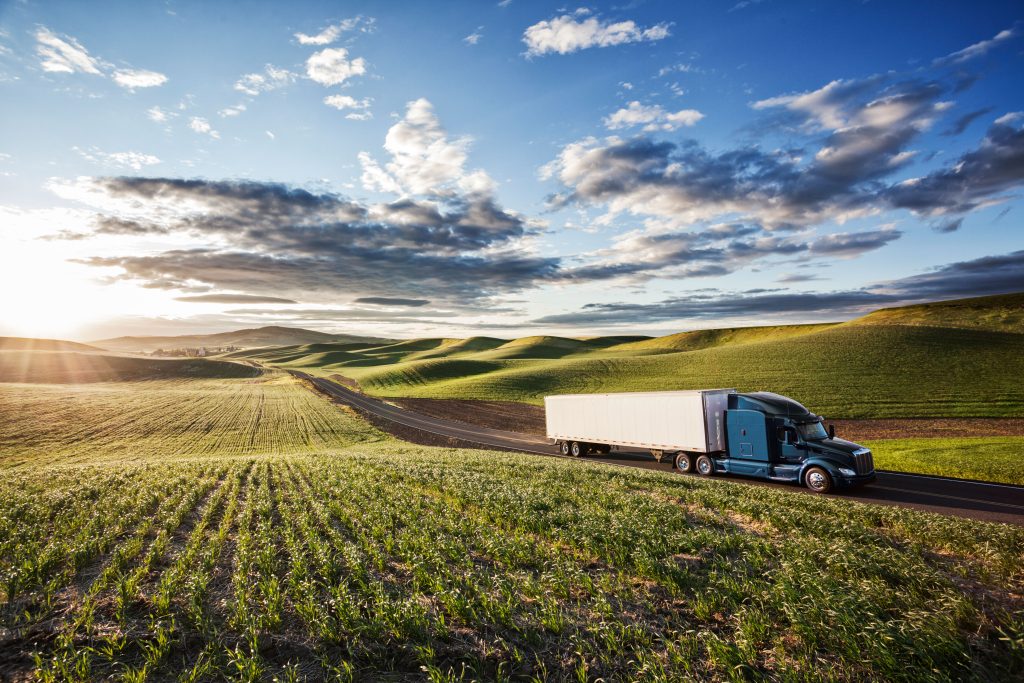
What We’re Doing: AI for Smarter Freight Matching & Carbon Reduction
Here at TILT.ai we have recently been awarded a UK Government grant to tackle this exact issue and develop technology that leverages these efficiencies, to specifically target Carbon Emission profiles for Logistics companies.
Carbon-aware decision making
Information is essential for making eco-focussed freight decisions. Our AI-driven platform delivers real-time emissions data—before and after booking—so teams can compare options, predict each shipment’s footprint, and choose the most appropriate route. We also give shippers a portfolio-wide view of emissions by lane and provide integrated offsetting options, helping them reduce and then responsibly neutralise their remaining footprint.
For each planned trip, our system:
- Estimates emissions based on distance, speed profile, vehicle type, fuel, and weight
- Compares alternative options (e.g. backhaul vs empty move, slightly longer route with better consolidation, or even shifting to rail/intermodal where available). (ctl.mit)
- In the UI, you can analyse emissions deltas: “This route is +3% in transit time but –12% CO₂e.” Giving the user all the data available to make decisions.
Freight matching: using ML to reduce deadheading
Industry case studies already show 10–15% reductions in empty miles when AI is allowed to design truck routes.(BusinessTech.) Our aim is to bring that kind of performance – or better – into our network, with a clear line of sight from algorithms to avoid emissions.
Our objective is to minimise empty and sub-optimal moves while preserving service and compliance.
Inputs we use:
- Historical loads and lanes from our TMS
- Real-time truck locations and availability
- Equipment type, weight/volume constraints
- Driver hours-of-service and home-time rules
- Shipper and carrier preferences.
How the AI behaves:
- Forecasts likely load opportunities by lane and time window.
- Suggests “next best load” for each truck, considering both revenue and future positioning.
- Builds multi-leg plans that try to turn what would be an empty reposition into a paid move.
This project promises to deliver significant improvements across 4 key KPI’s:
- Deadhead mileage reduction
- Operational cost savings (Cost-per-mile analysis)
- Increased revenue per mile for carriers
- Lower carbon emissions per trip
“Together, our goal is simple: use AI-powered technology to deliver efficient, secure, low-cost freight transportation that unlocks value for shippers, brokers, and carriers—while steadily shrinking the carbon footprint of every mile moved.”